Detailed project
The aim of this project is to develop modelling tools for
problems involving fluid mechanics in order to
explain, to control, to simulate and possibly to predict
some complex phenomena coming from physics,
chemistry, biology or scientific engineering. The
complexity may consist of the model itself, of the
coupling
phenomena, of the geometry or of non-standard
applications. The challenges of the scientific team are to
develop stable models and efficient adapted numerical
methods in order to recover the main physical features
of the considered phenomena. The models will be
implemented into numerical codes for practical and
industrial applications.
We are interested in both high and low Reynolds number
flows, interface and control problems in physics and
biology.
We are interested in both high and low Reynolds number
flows, interface
and control problems in physics and biology.
In the next paragraphs, we explain our main goals, we describe our project in terms of development of numerical techniques and we present the team with the competence of the members.
Modelling
The first goal of the project consists in modelling some complex phenomena. We combine the term model with the three following adjectives: phenomenological, asymptotical and numerical.
Phenomenological : use of ad-hoc models in order to represent some precise phenomena. One example of such modelling process is the construction of nonlinear differential laws for the stress tensor of visco-elastic fluids or for wormlike micelles. Another example is the wall law conditions in microfluidics (fluids in microchannels) that are often taken heuristically in order to model the slip at the boundary. In biology, since no fundamental laws are known, the modeling is exclusively phenomenological especially concerning the modeling of tumor growth.
Asymptotical : using asymptotic expansions, we derive simpler models containing all the relevant phenomena.
Examples of such a process are the penalization method for the simulation of incompressible flows with
obstacles or the analysis of riblets in microfluidics that are used to control the mixing of the fluids. Another
example is the use of shallow fluid models in order to obtain fast predictions (Hele-Shaw approximation in
microfluidics) or the approximation of thin membranes for the modeling of electroporation of cells.
Numerical : direct numerical tools are used to simulate the modelized physical phenomena. A precise analysis
of the models is performed to find out the most convenient numerical method in terms of stability, accuracy
and efficiency. A typical example is the POD (proper orthogonal decomposition) and its use in control theory,
or in data assimilation in tumor growth, to obtain fast simulations.
Analysis and computation
Once the model has been determined, we perform its mathematical analysis. This analysis includes the effect of boundary conditions (slip conditions in microfluidics, conditions at an interface...) as well as stability issues (stability of a jet, of an interface, of coherent structures). The analysis can often be performed on a reduced model. This is the case for an interface between two inviscid fluids that can be described by a Boussinesq-type system. This analysis of the system clearly determines the numerical methods that will be used. Finally, we implement the numerical method in a realistic framework and provide a feedback to our different partners.
Applications
Our methods are used in four areas of applications.
1)Interface problems and complex fluids: This concerns microfluidics, complex fluids (bifluid flows, miscible fluids). The challenges are to obtain reliable models that can be used by our partner Rhodia (for microfluidics).
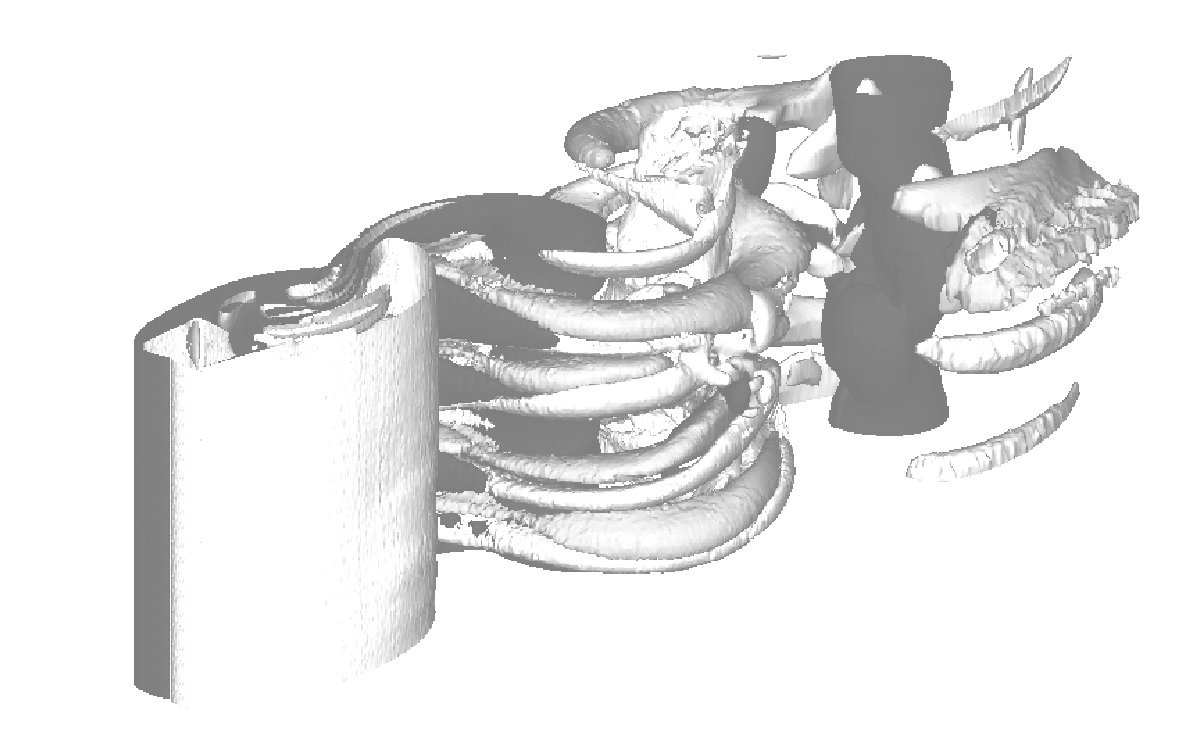
2)High Reynolds flows and their analysis: We want to develop numerical methods in order to address the complexity of high Reynolds flows. The challenges are to find scale factors for turbulent flow cascades, and to develop modern and reliable methods for computing flows in aeronautics in a realistic configuration.
3) Control and optimization: the challenges are the drag reduction of a ground vehicle in order to decrease the fuel consummation, the reduction of turbomachinery noise emissions or the increase of lift-to-drag ratio in airplanes, the control of flow instabilities to alleviate material fatigue for pipe lines or off-shore platforms and the detection of embedded defects in materials with industrial and medical applications.
4) Tumor growth: The challenge is to produce patient-specific simulations starting from medical imaging for growth of metastasis to the lung of a distant tumor.
Our main partners on this project will be :
Industrial: Renault, IFP, CIRA (Centro italiano ricerche aerospaziali), Airbus France and Boeing for high Reynolds flows, optimization and control and Rhodia (biggest french company of chemistry) for interface problems and complex fluids.
Academic: CPMOH (Laboratory of Physics, Bordeaux 1 University) for high Reynolds flows, optimization and control, and Institut Gustave Roussy (Villejuif), University of Alabama at Birmingham and Institut Bergonié (Bordeaux) for tumor growth, optimad (spin-oof of the Politecnico de Torino) for simulations of complex flows.